

Next Session:
| Apr 22nd 2013 (6 weeks long) |
Workload: 6-8 hours/week
About the Course
For students who have long thought about picking up the acoustic or electric guitar, this course will provide an easy-access foundation that will get you playing. When first learning guitar, it is important to have the material presented in stages, in an enjoyable way that allows you to grasp the basics of the instrument and music. The course begins simply with the parts of the guitar, the names of the strings, tuning, and technique—whether finger-style or pick. It then explores the basics of music theory with such topics as scales, triads, power chords, and fingering and shapes.
At the end of this course, students will understand the structure, parts, and accessories of the instrument, in addition to an understanding of its basic maintenance. Electric guitar players will learn the operation of their instrument along with basic options for amplification, effect pedals, and sounds. Students will also learn to develop correct technique and apply theory concepts to their playing. They will have the foundational knowledge necessary to pursue most intermediate guitar courses.
At the end of this course, students will understand the structure, parts, and accessories of the instrument, in addition to an understanding of its basic maintenance. Electric guitar players will learn the operation of their instrument along with basic options for amplification, effect pedals, and sounds. Students will also learn to develop correct technique and apply theory concepts to their playing. They will have the foundational knowledge necessary to pursue most intermediate guitar courses.
About the Instructor(s)
Thaddeus Hogarth is an associate professor 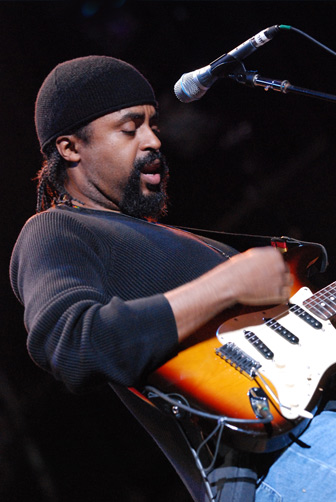 in the Guitar department at Berklee College of Music. A two-time winner of the Independent Music Award for R&B/Blues, Thaddeus has been a prominent guitar player and singer-songwriter on the music scene since 1988, when he graduated from Berklee. He leads his own group, the Thaddeus Hogarth Band, featuring David Buda on bass, Joey Scrima on drums, and David Sparr on keyboards. Thaddeus has shared the bill or stage with such legends as Tower of Power, Average White Band, Ernie Isley, James Montgomery, Fred Wesley, Eric Gales, and Johnny Winter. His work also includes collaboration with the reggae legend and Grammy nominee, Sister Carol. He has released four solo CDs, a live concert DVD, and an instructional book. Thaddeus authored and currently teaches the course Funk/Rock and R&B Guitar Soloing for Berkleemusic.com, the online continuing education division of Berklee College of Music.
in the Guitar department at Berklee College of Music. A two-time winner of the Independent Music Award for R&B/Blues, Thaddeus has been a prominent guitar player and singer-songwriter on the music scene since 1988, when he graduated from Berklee. He leads his own group, the Thaddeus Hogarth Band, featuring David Buda on bass, Joey Scrima on drums, and David Sparr on keyboards. Thaddeus has shared the bill or stage with such legends as Tower of Power, Average White Band, Ernie Isley, James Montgomery, Fred Wesley, Eric Gales, and Johnny Winter. His work also includes collaboration with the reggae legend and Grammy nominee, Sister Carol. He has released four solo CDs, a live concert DVD, and an instructional book. Thaddeus authored and currently teaches the course Funk/Rock and R&B Guitar Soloing for Berkleemusic.com, the online continuing education division of Berklee College of Music.Course Syllabus
Lesson 1: Acoustic or Electric Guitar?
Parts Options, Accessories, Quick Start to PlayingLesson 2: The Basics—All You Need to Know to Start
String Names, Tuning, Pick Technique, Finger-Style, StrummingLesson 3: Twelve Tones = Twelve Frets
Frets, Notes on the Staff, Notes on the Fretboard, Notes on the Staff, Rhythm, Time SignatureLesson 4: Scales—The What's and Why's
Position Playing, Chromatic Scale, Major Scales, Half Steps, Whole Steps, Keys, Sharps FlatsLesson 5: Easy Chords—Triads/Power Chords
Basic Harmony, Power Chords, Easy Fingerings for Major and Minor Chords, SongsLesson 6: The Pentatonic Scale—The Guitarists Best Friend
Fingerings, Soloing, Electric Guitar Effects and Amplification, Acoustic Amplificiation
Recommended Background
No musical experience or ability to read music is required.
Suggested Readings
The Quest for Good Guitar Tone by Thaddeus Hogarth
Course Format
The course consists of video demonstrations, with integrated quizzes that allow you to reinforce your knowledge of the material before moving on. You will also have assignments that ask you to submit basic recorded examples of your playing for peer review.
FAQ
- What kind of guitar should I have for the course?
Students should have either an electric or acoustic guitar.
- What do I need in order to record my assignments?
During the course, you will be asked to submit recorded examples of your playing. In order to do this, you will need your computer's built-in microphone or an external microphone plugged directly into your computer (via built-in ports or an external audio interface), in addition to basic audio recording software, such as Audacity, that will allow you to record yourself playing and save the recording in MP3 format.
No comments:
Post a Comment